-
RESTOCKING
-
RESTOCKING

-
RESTOCKING

-
RESTOCKING

-

-
RESTOCKING

-

-
RESTOCKING

-
-

-

RADAR
RADAR Notes: Enter the Fascinating World of Palindrome Collecting
Collecting RADAR Goldbacks by Serial Number
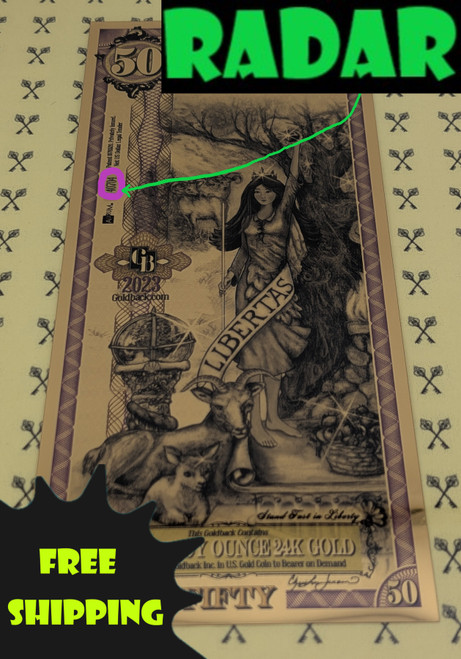
Discover the fascinating world of palindrome serial numbers and the Goldbacks that collectors call RADAR notes.
Every Goldback carries a unique serial number. For many collectors, that number is more than an identification mark—it can become part of what makes a particular Goldback special.
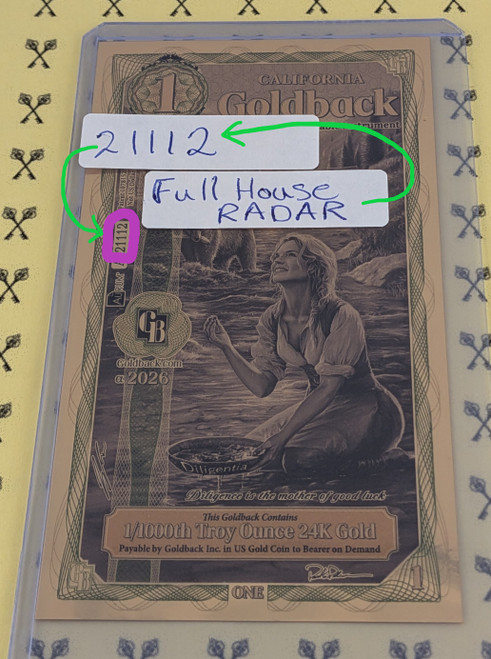
One of the most recognizable categories of collectible serial numbers is the RADAR number. In paper-money collecting, a RADAR serial number is a palindrome: it reads the same from left to right and from right to left.
Why is it called a RADAR?
The word RADAR itself is a palindrome—it reads the same forward and backward. The term has become established in paper-money collecting for palindromic serial numbers.
What Is a RADAR Goldback?
A RADAR Goldback is a Goldback whose serial number reads identically in either direction. For a five-digit Goldback serial number, the pattern can be represented as:
A B C B A
Five-digit RADAR pattern
Five-digit RADAR pattern
In other words, the first and fifth digits must match, and the second and fourth digits must match. The center digit can be any number.
Examples of RADAR Goldback Serial Numbers
Here are some examples of five-digit serial numbers that form a RADAR:
Notice that the digits do not need to be consecutive or all identical. What matters is the symmetry of the entire serial number.
How to Check Your Goldback for a RADAR
You don't need special equipment to identify a RADAR serial number. A quick three-step check is all it takes.
1
Read the five digits.
Look at the complete serial number from left to right.
Look at the complete serial number from left to right.
2
Compare the outside digits.
The first and fifth digits must be identical.
The first and fifth digits must be identical.
3
Compare the inside digits.
The second and fourth digits must be identical. The middle digit can be anything.
The second and fourth digits must be identical. The middle digit can be anything.
Not a RADAR: 50704
The first digit is 5 while the last digit is 4, so the number does not read the same backward.
The Reverse Test
There is an even simpler method: reverse the serial number in your head. If the reversed number is exactly the same as the original, you've found a RADAR.
✓ RADAR
34843
Reverse it → 34843
✗ Not RADAR
34847
Reverse it → 74843
Why Collect RADAR Goldbacks?
RADAR Goldbacks appeal to collectors because they combine the physical collectability of the Goldback with a distinctive mathematical pattern found directly in the note's serial number.
A Goldback Can Have Multiple Collectible Attributes
- State and series
- Year and denomination
- Artwork and design
- Edition or special release
- Condition and grading
- Unique or desirable serial number
A RADAR serial number adds another layer to the collecting experience. Two Goldbacks can have the same denomination and design, yet one may have a much more memorable serial number.
The appeal is also easy to understand. Unlike some collectible varieties that require magnification or specialized knowledge, the RADAR pattern can be recognized simply by looking at the serial number.
The Mathematics Behind a Five-Digit RADAR
A five-digit serial number can contain 100,000 possible combinations when numbers from 00000 through 99999 are considered.
A RADAR number has the form ABCBA. Once the first three digits are selected, the last two are determined automatically to create the palindrome.
ABCBA
1,000 possible five-digit palindrome patterns out of 100,000 five-digit combinations
Approximately 1% of five-digit combinations
This mathematical structure is one reason RADAR numbers stand out. They aren't simply random numbers that happen to look interesting—the digits have a specific relationship to one another.
Some RADARs Are More Memorable Than Others
Every RADAR satisfies the basic palindrome requirement, but collectors may find some patterns particularly attractive or memorable.
Some serial numbers can even combine multiple desirable characteristics. For example, 77777 is a RADAR because it reads the same in either direction, but it also has five identical digits. This kind of overlapping pattern can make an individual Goldback especially interesting to a collector.
The Fun Is in the Hunt
One of the most enjoyable aspects of RADAR collecting is the search. Collectors can check Goldbacks already in their collections, examine newly acquired notes, and search available inventory for a particular numerical pattern.
This turns the serial number into part of the collecting adventure. A collector may begin by simply checking every note for a RADAR and eventually start looking for increasingly memorable patterns.
Don't Overlook the Serial Number
The next time you receive a Goldback, take a close look at those five digits. Compare the first and fifth. Compare the second and fourth. Then read the entire number backward.
Does it read the same both ways?
If it does, you may have discovered a RADAR Goldback—a note whose serial number has the kind of symmetry that can make it especially interesting to collectors.
Collect the Goldback. Discover the pattern. Find the RADAR.