Number Pattern, RADAR & ZIP Code Serial Numbers
If you collect Goldbacks, there is another exciting detail worth checking every time you pick up a note: the serial number. Beyond the denomination, year, state, Alpha designation, artwork, and gold content, the serial number can make an individual Goldback particularly interesting to collectors.
Number Pattern Notes: Collect the Numbers That Make a Note Special
A New Way to Collect
The Number Can Make the Note Special
Goldbacks, Silverbacks, and other collectible notes can be appreciated for their artwork, precious-metal content, history and limited production. But sometimes there is another reason to save a particular note: the serial number.
Number Pattern Notes are collectible Goldbacks, Silverbacks, and other notes with a unique, unusual, recognizable, or memorable serial-number pattern.
The idea is simple: instead of treating every serial number as a random string of digits, collectors look for numbers that stand out. Repeated numbers, combinations, sequences and other recognizable patterns can make an individual note much more interesting to collect.
This is part of a broader tradition in banknote collecting. Collectors of fancy serial numbers have long searched for solids, radars, ladders, repeaters and other distinctive arrangements. The appeal comes from the fact that the serial number is unique to an individual note.
What Is a Number Pattern Note?
A Number Pattern Note is a note whose serial number forms a recognizable and memorable combination of numbers. The pattern itself becomes part of the collectible identity of the note.
Inspired by Five-Card and Five-Dice Combinations
Many people are familiar with the idea of looking at five numbers and recognizing a combination. Five-card games and five-dice games use recognizable combinations such as three of a kind, four of a kind and full house.
Number Pattern Notes take that familiar idea and apply it to the five-digit serial number of a collectible note. Instead of playing a game, however, the collector is searching for, identifying and preserving an unusual number.
The Fun Is in Recognizing the Pattern
A five-digit serial number can contain patterns that immediately catch the eye. Once collectors learn what to look for, every note becomes a potential discovery.
GoldIsBack Number Pattern Notes
GoldIsBack.com has created a collection of Number Pattern Notes for collectors who enjoy finding these memorable serial-number combinations.
Current categories include:
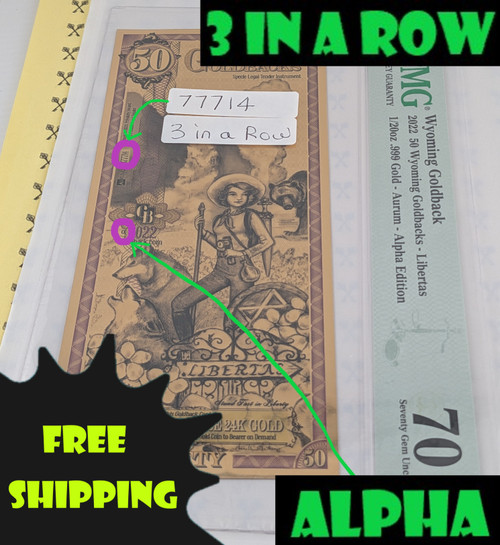
Three of a Kind
Three of the five digits are the same, creating a recognizable three-of-a-kind combination.
Full House
Three of one digit and two of another create a memorable 3-and-2 combination.
4 in a Row
Four identical digits occur consecutively, creating a striking visual pattern.
5 in a Row
All five digits are identical. Examples include 55555, 77777 and 88888.
Three of a Kind
A Three of a Kind Number Pattern contains three matching digits within the five-digit serial number.
77742
The three 7s immediately make this number more memorable than a random five-digit sequence.
Full House
A Full House Number Pattern combines three of one digit with two of another.
77722
The 3-and-2 arrangement creates a balanced and easily recognizable five-digit combination.
4 in a Row
A 4 in a Row note contains four identical digits consecutively.
47777
Because the four repeated digits are next to one another, the pattern has a strong visual impact.
5 in a Row
The Ultimate Repeating Pattern
77777
A 5 in a Row note contains five identical digits. Every digit is the same.
Examples include 55555, 77777, 88888 and 99999. These numbers are immediately recognizable and can be especially attractive to collectors who specialize in repeating serial numbers.
Why Can Number Patterns Add Collectible Appeal?
The serial number is one of the characteristics that makes an individual note different from another note of the same issue. In traditional banknote collecting, recognizable serial-number patterns can attract collectors and sometimes command premiums, although rarity, condition and collector demand all influence actual market value.
Number Pattern Notes take that idea and make the pattern itself part of the collecting experience.
More Than a Random Number
Imagine owning two otherwise similar notes. One has a completely random serial number. The other has:
77777
The second note has a number that is immediately recognizable, memorable and easy to explain to another collector. That is the appeal of a Number Pattern Note.
Collect the Pattern — Not Just the Note
Number Pattern collecting gives collectors another way to organize a collection. Instead of collecting only by year, denomination, state or design, you can build a collection around the numbers themselves.
You might collect every type of Number Pattern. You might specialize in one favorite number. Or you might search for particularly difficult combinations.
Collect by Pattern
Build a set containing Three of a Kind, Four of a Kind, Full House and more.
Collect by Number
Search for your favorite number appearing in different patterns.
Collect by Note
Find patterns across Goldbacks, Silverbacks and other collectible notes.
Start Looking at Your Serial Numbers
The next time you receive a Goldback, Silverback or other collectible note, take a closer look at the serial number.
What initially appears to be five random digits might actually be a Three of a Kind, 3 in a Row, Four of a Kind, Full House, 4 in a Row or 5 in a Row.
The Number Pattern Collector's Checklist
- ☐ Look at all five digits.
- ☐ Look for repeated digits.
- ☐ Look for consecutive repeated digits.
- ☐ Look for a 3-and-2 combination.
- ☐ Look for four matching digits.
- ☐ Look for five matching digits.
- ☐ Check whether the number has another special characteristic.
- ☐ Save the note if the pattern makes it special to you.
NUMBER PATTERN NOTES
Find the Number. Discover the Pattern.
Collect the notes that stand out.
Because sometimes the number is what makes the note memorable.
Collector's Note: A Number Pattern can add collector interest, but a particular pattern does not guarantee a specific market value or premium. Rarity, condition, denomination, series, production characteristics and collector demand can all affect the value of a collectible note.
RADAR Notes
RADAR Notes are like the word RADAR. The digital part of the serial number of the note is the same when read from left-to-right or right-to-left.
ZIP Code Notes
ZIP Code Serial Number Notes use the 5-digit serial number to refer to a ZIP Code of a particular city. Find your hometown, a famous location or collect from your current state.